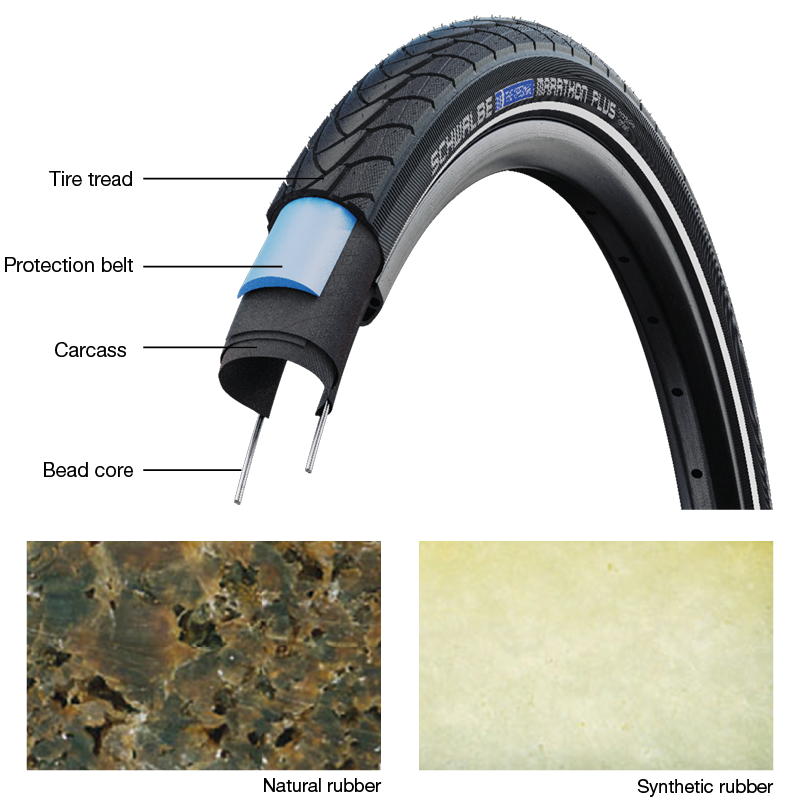
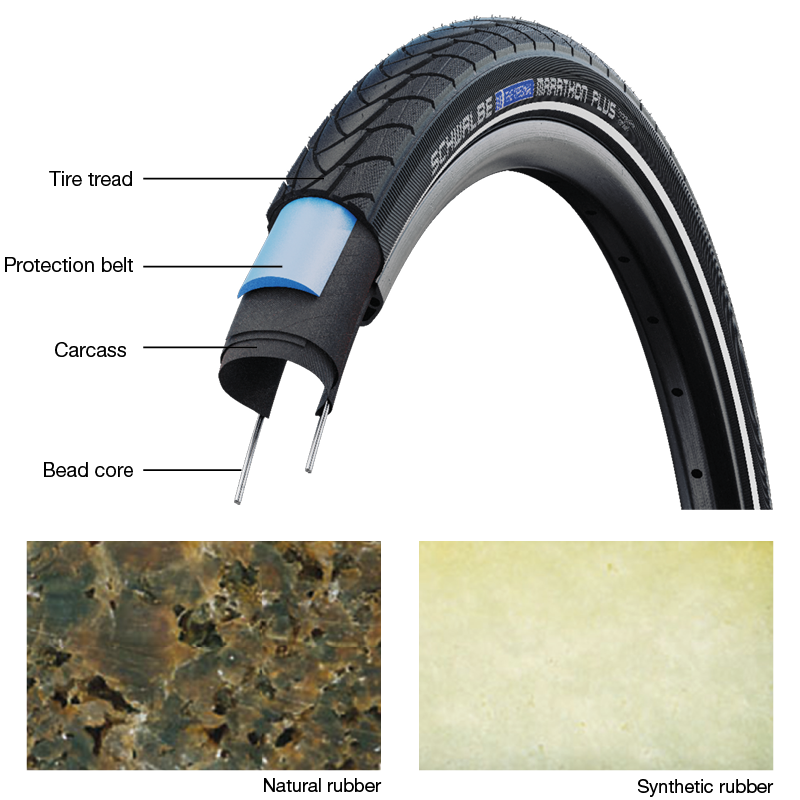
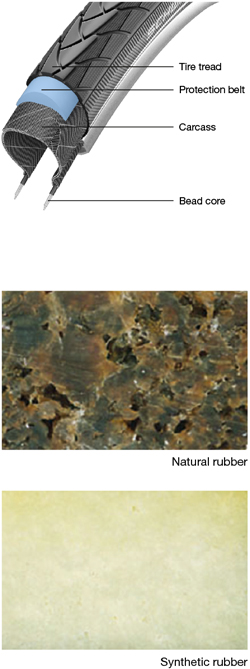
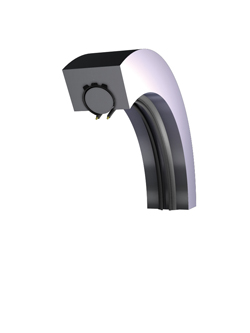
A bicycle tire consists of three basic elements: the carcass, the bead core and the rubber tread. Furthermore, almost all Schwalbe tires have a puncture protection belt. Depending on the compound, the rubber content is around 40-60%. The filler amounts to 15-30% and the remaining components approx. 20-35%.
The bead core of the tire determines its diameter and ensures a secure seat on the rim. Generally the bead core of a tire consists of a wire bundle. In folding tires, the wire is replaced with a hoop of aramid fibers.
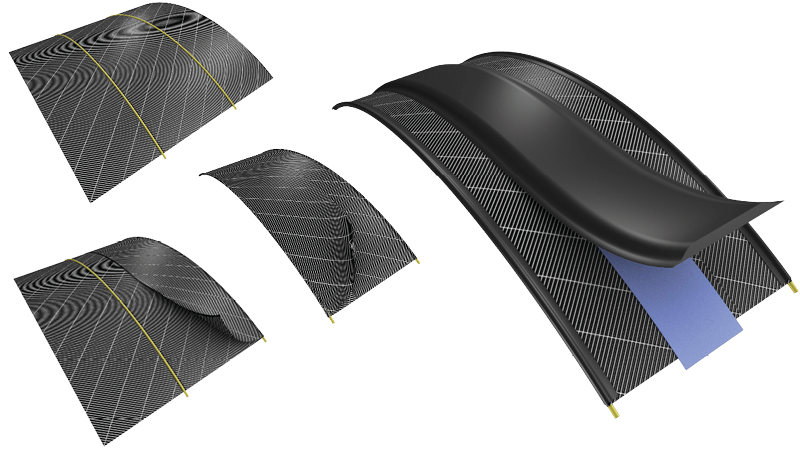
The carcass is the “framework” of the tire. The textile material is rubber coated on both sides and cut at a 45 degree angle. With this angle placed in the rolling direction, the carcass provides the tire’s necessary stability. All Schwalbe carcasses are made of polyamide (nylon). Depending on the quality requirements of the tire, the carcass materials are woven in various densities.
The rubber compound of a tire consists of several components:
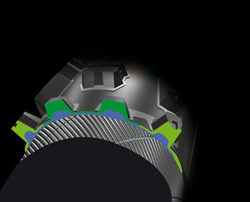
Almost all Schwalbe tires have a puncture protection belt, with the exception of special lightweight and sports tires, where this feature is purposely excluded. Even our standard tires are equipped with an effective puncture protection belt made of natural rubber and reinforced with Kevlar® fibers (K-Guard). In the case of the Marathon tires the 3 mm thick GreenGuard ensures the renowned high puncture protection.
Furthermore, our top of the range tires have highly efficient puncture protection systems, which are specifically adapted to particular requirements, for example RaceGuard, V-Guard or SmartGuard.
WHAT COMPONENTS MAKE UP A TIRE?
A bicycle tire consists of three basic elements: the carcass, the bead core and the rubber tread. Furthermore, almost all Schwalbe tires have a puncture protection belt.
The bead core of the tire determines its diameter and ensures a secure seat on the rim. Generally the bead core of a tire consists of a wire bundle. In folding tires, the wire is replaced with a hoop of aramid fibers.
The carcass is the “framework” of the tire. The textile material is rubber coated on both sides and cut at a 45 degree angle. With this angle placed in the rolling direction, the carcass provides the tire’s necessary stability. All Schwalbe carcasses are made of polyamide (nylon). Depending on the quality requirements of the tire, the carcass materials are woven in various densities.
The rubber compound of a tire consists of several components:
- Natural and synthetic rubber
- Fillers, e.g. carbon black, chalk, silica
- Softeners, e.g. oils and lubricants
- Anti-aging agents (aromatic amines)
- Vulcanizing aids, e.g. sulphur
- Vulcanization accelerators; e.g. zinc oxide
- Pigments and dyes
Depending on the compound, the rubber content is around 40-60%. The filler amounts to 15-30% and the remaining components approx. 20-35%.
Almost all Schwalbe tires have a puncture protection belt, with the exception of special lightweight and sports tires, where this feature is purposely excluded. Even our standard tires are equipped with an effective puncture protection belt made of natural rubber and reinforced with Kevlar® fibers (K-Guard). In the case of the Marathon tires the 3 mm thick GreenGuard ensures the renowned high puncture protection.
Furthermore, our top of the range tires have highly efficient puncture protection systems, which are specifically adapted to particular requirements, for example RaceGuard, V-Guard or SmartGuard.
HOW IS A BICYCLE TIRE MANUFACTURED?
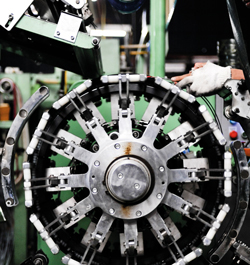
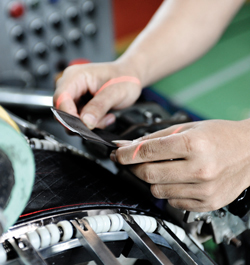
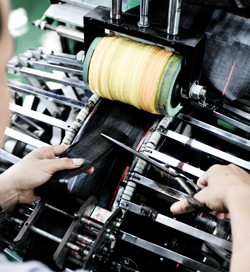
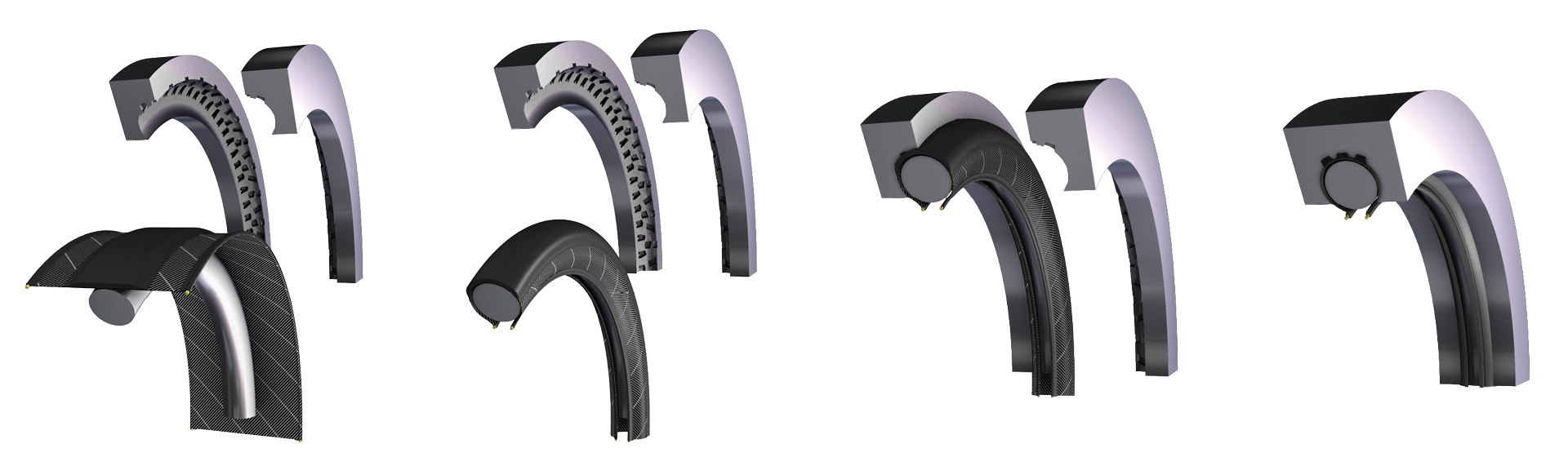
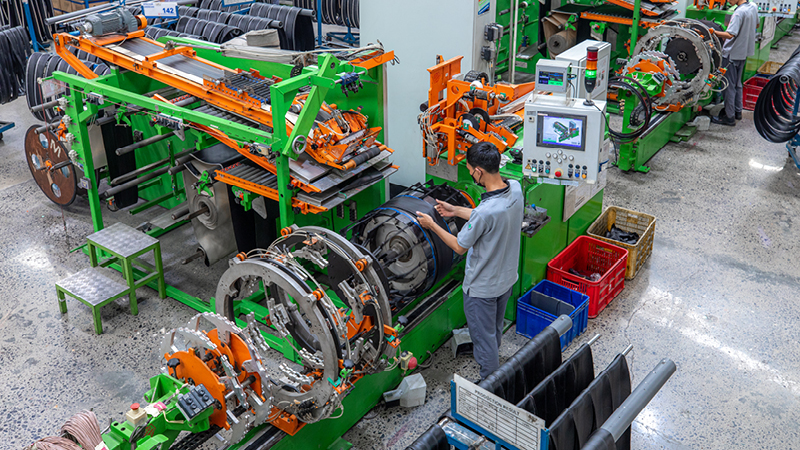
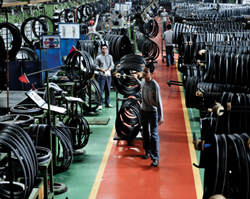
The tire is manufactured from the prepared materials in a unique process. This is highly labor intensive and of course facilitated by using the latest modern machinery.
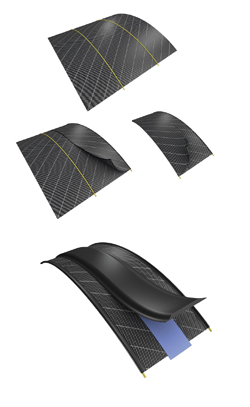
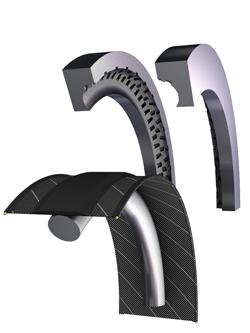
The carcass is applied to the building drum, cut and then sliced. As a next step, the wire or aramid bundles are inserted and the carcass is folded from both sides. The 45 degree-angle carcass material is now layered and forms a tire with a diagonal structure.
In this phase, the respective puncture protection layer is inserted. Finally, the tread is applied exactly in the center of the tire.
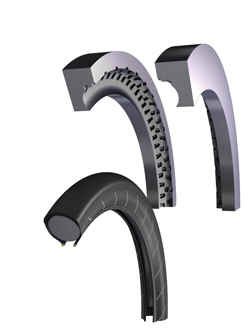
But the green tire is still in a pliable form without a tread. Only during the vulcanization process in the mold, does the tire get its tread and its elastic properties.
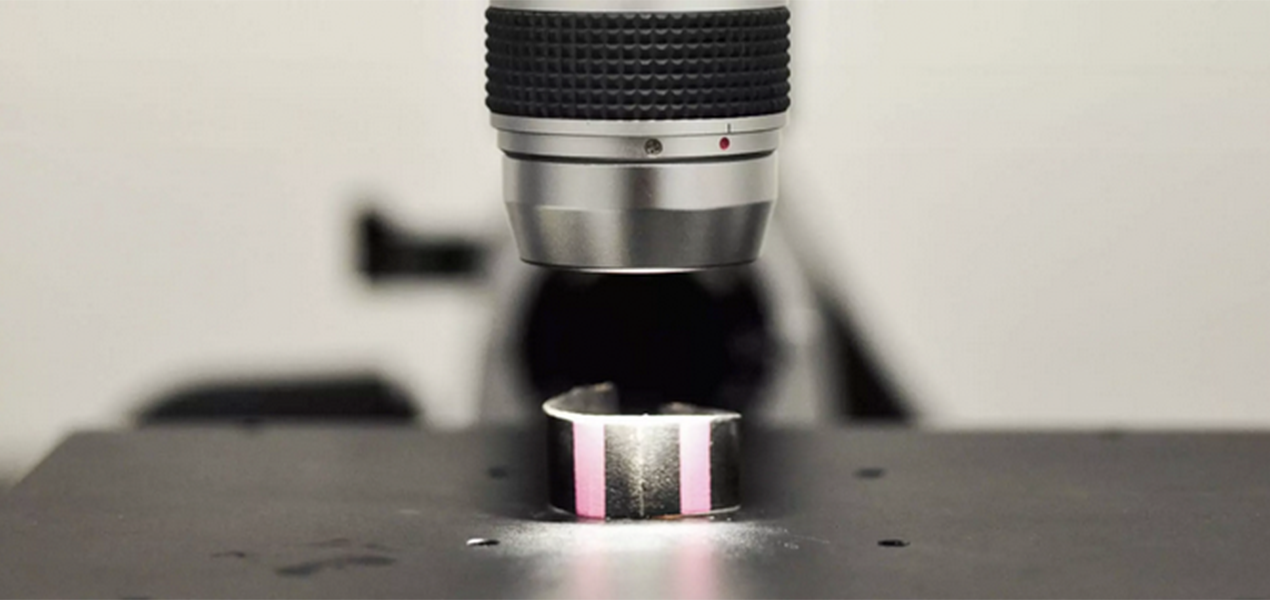
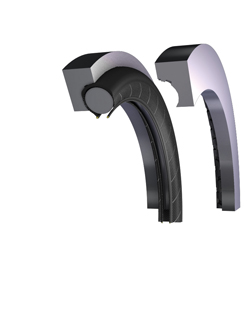
The green tire is pressed into a tire mold by a special heating tube and – like in a waffle iron - vulcanized at approx. 170 degrees for five to six minutes.
Only after vulcanization can it be called rubber. Now the tire has its elastic properties and its tread. After the production process every tire undergoes a strict quality control. Every tire is meticulously inspected once again. Continuous checking of random samples ensures correct weight and run-out.
AUS WELCHEN TEILEN BESTEHT EIN FAHRRADREIFEN?
Lorem Ipsum dolor sit amet
Lorem ipsum dolor sit amet, consetetur sadipscing elitr, sed diam nonumy eirmod tempor invidunt ut labore et dolore magna aliquyam erat, sed diam voluptua. At vero eos et accusam et justo duo dolores et ea rebum. Stet clita kasd gubergren, no sea takimata sanctus est Lorem ipsum dolor sit amet. Lorem ipsum dolor sit amet, consetetur sadipscing elitr, sed diam nonumy eirmod tempor invidunt ut labore et dolore magna aliquyam erat, sed diam voluptua. At vero eos et accusam et justo duo dolores et ea rebum. Stet clita kasd gubergren, no sea takimata sanctus est Lorem ipsum dolor sit amet.
WHERE ARE SCHWALBE TIRES MANUFACTURED?
WIE WIRD EIN FAHRRADREIFEN GEFERTIGT?
Anker
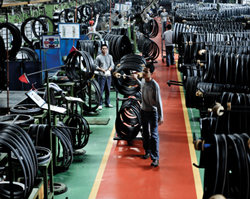
Alle Schwalbe Reifen und Butyl-Schläuche werden in unseren Produktionsstätten in Indonesien und Vietnam hergestellt. Die Produktion läuft in einem gemeinsamen Joint Venture der Ralf Bohle GmbH mit dem koreanischen Familienunternehmen Hung-A.
Dass Schwalbe Reifen in Indonesien und Vietnam gefertigt werden, liegt an der Geschichte der Firma. Die Firma Bohle war früher ein ganz kleines Handelshaus, das mit Fahrradteilen aller Art gehandelt hat. Die Schwalbe Story beginnt im Jahre 1973 als unser Firmengründer Ralf Bohle erstmals Fahrradreifen von Korea nach Deutschland importierte. Dieses Geschäft war für ihn so interessant, dass er sich fortan voll und ganz darauf konzentriert hat. Damals wie heute wird das Geschäft in enger Partnerschaft mit Hung-A betrieben - so werden die Reifen seit dem Start der Ralf Bohle GmbH in Asien produziert.
Lorem Ipsum dolor sit amet
Lorem ipsum dolor sit amet, consetetur sadipscing elitr, sed diam nonumy eirmod tempor invidunt ut labore et dolore magna aliquyam erat, sed diam voluptua. At vero eos et accusam et justo duo dolores et ea rebum. Stet clita kasd gubergren, no sea takimata sanctus est Lorem ipsum dolor sit amet. Lorem ipsum dolor sit amet, consetetur sadipscing elitr, sed diam nonumy eirmod tempor invidunt ut labore et dolore magna aliquyam erat, sed diam voluptua. At vero eos et accusam et justo duo dolores et ea rebum. Stet clita kasd gubergren, no sea takimata sanctus est Lorem ipsum dolor sit amet.
WHAT IS THE REASON FOR SCHWALBE MANUFACTURING THEIR TIRES IN ASIA?
Das liegt wie oben beschrieben u.a. an der Geschichte der Firma. Schwalbe Reifen wurden noch nie in Deutschland hergestellt. In Zusammenarbeit mit unserem koreanischen Partnerunternehmen Hung-A, wurden nach dem ursprünglichen Standort in Korea zunächst Produktionsstätten in Indonesien, später in Vietnam errichtet.
Aus der Region Südostasien kommt zudem der wichtigste Rohstoff für die Reifenfertigung – Naturkautschuk. Bei einer Produktion in Europa müssten die meisten Vormaterialien importiert werden.
Ein weiterer Grund ist, dass ein Großteil der Fahrradindustrie ihre Fahrräder in asiatischen Ländern produzieren lässt. Die Lieferwege für unser Zubehörprodukt vom Werk bis zur Montage an Neufahrrädern sind dadurch vergleichsweise kurz.
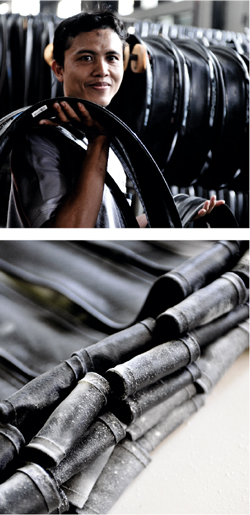
WHAT ARE THE WORKING CONDITIONS IN THE SCHWALBE PRODUCTION FACILITIES?
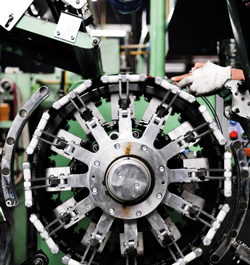
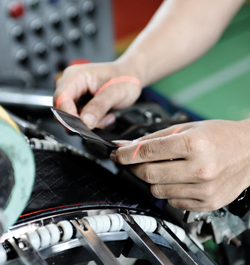
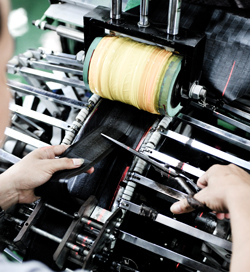
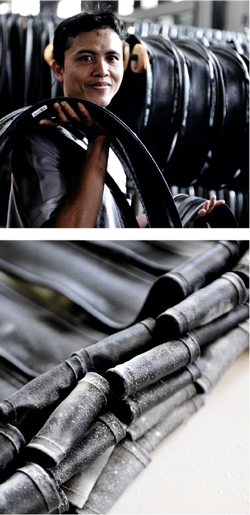
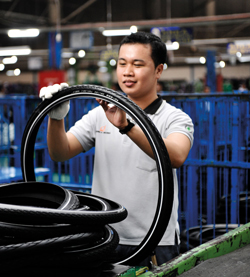
Gearbeitet wird in drei Schichten. Eine Schicht dauert acht Stunden, die Arbeitswoche hat in Indonesien und Vietnam üblicherweise sechs Tage. Das Lohnniveau liegt jeweils deutlich über dem Landesdurchschnitt. Wir haben ein großes Interesse daran, unsere Mitarbeitenden in Indonesien und Vietnam durch ein gutes Arbeitsumfeld zu binden. Ein Beispiel dafür: Die Fertigung eines Fahrradreifens besteht zu einem großen Anteil aus Handarbeit. Die Erfahrung und das persönliche Geschick der Arbeiter und Arbeiterinnen an den Konfektionsmaschinen haben daher einen sehr großen Einfluss auf die Qualität des fertigen Reifens.
Und zuverlässig gleich hohe Qualität ist eine der essenziellen Eigenschaften der Reifen von Schwalbe!
WHAT DOES EPI MEAN IN RELATION TO THE CARCASS?
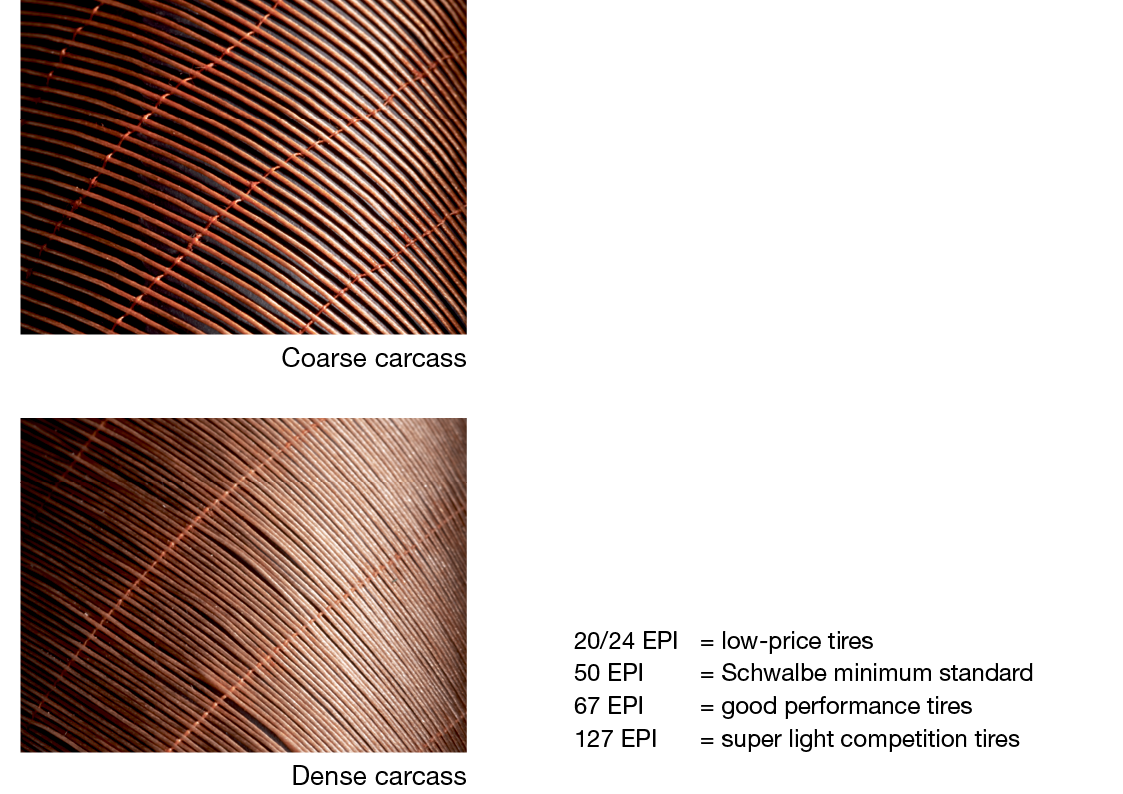
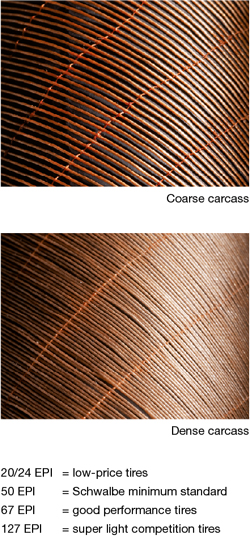
The density of the carcass fabric is expressed in EPI or TPI (Ends Per Inch, Threads Per Inch). The range of carcasses used, for example, for bicycle tires are 20, 24, 37, 50, 67 and 127 EPI. In principle, the more close-meshed a carcass is woven, the higher the quality of the tire. A dense carcass is important for low rolling resistance and good riding properties. At the same time, puncture protection increases, because carcasses with a high strand density are difficult to puncture. However, this does not apply to the extremely fine 127 EPI carcasses, as each strand is sheer and quite vulnerable. The best compromise for low weight and resistance is around 67 EPI. In most of our top tires we use a 67 EPI carcass. Weight and rolling resistance can be reduced even further by using a 127 EPI carcass. But at the same time, these tires are more vulnerable to damage. Therefore, we intentionally use the 127 EPI carcasses only for light competition tires, where weight is an important factor. Most bicycle tires worldwide are certainly manufactured with coarse 20 or 24 EPI materials. This material has no longer been used at all by Schwalbe for a couple of years now. Even very low-priced Schwalbe tires already have a state-of-the-art 50 EPI carcass. But be cautious when comparing EPI indications, as often the number of strands of all carcass layers are added together. An indication of 200 TPI results e.g. from 3 layers of 67 EPI each underneath the tread. With all EPI numbers above 150, it should be assumed that the figures have been calculated by adding up the strands in all layers. Schwalbe only indicates the material density in one carcass layer. Commonly, there are 3 carcass layers underneath the tread.
WO WERDEN SCHWALBE REIFEN HERGESTELLT?
DOES A PERFECT RUBBER COMPOUND EXIST?
Die Gummimischung soll verschiedene Eigenschaften erfüllen, die zum Teil gegenläufig sind: Geringer Rollwiderstand, gute Haftung, geringer Abrieb, lange Haltbarkeit, stabile Stollen (MTB), ...
An verschiedenen Stellen der Lauffläche – Unterbau, Schulter, Zentrum - kommen dann spezielle Gummimischungen zum Einsatz und spielen dort Ihre jeweiligen Stärken aus.
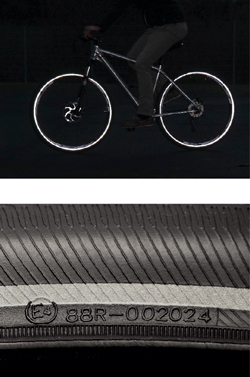
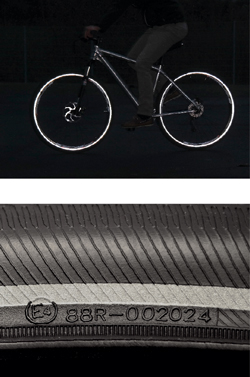
WHY ARE REFLECTIVE LINES USED?
Lorem Ipsum dolor sit amet
Lorem ipsum dolor sit amet, consetetur sadipscing elitr, sed diam nonumy eirmod tempor invidunt ut labore et dolore magna aliquyam erat, sed diam voluptua. At vero eos et accusam et justo duo dolores et ea rebum. Stet clita kasd gubergren, no sea takimata sanctus est Lorem ipsum dolor sit amet. Lorem ipsum dolor sit amet, consetetur sadipscing elitr, sed diam nonumy eirmod tempor invidunt ut labore et dolore magna aliquyam erat, sed diam voluptua. At vero eos et accusam et justo duo dolores et ea rebum. Stet clita kasd gubergren, no sea takimata sanctus est Lorem ipsum dolor sit amet.
WARUM FERTIGT SCHWALBE SEINE REIFEN IN INDONESIEN?
Die reflektierenden Streifen leuchten im Scheinwerferlicht extrem hell auf. Das Material ist retroreflektierend. Das heißt, es reflektiert genau in Richtung der Strahlungsquelle zurück. Durch die zwei reifengroßen Lichtkreise wird man sehr gut gesehen und als Radfahrer wahrgenommen.
WHY ARE REFLECTIVE LINES USED?
Lorem Ipsum dolor sit amet
Lorem ipsum dolor sit amet, consetetur sadipscing elitr, sed diam nonumy eirmod tempor invidunt ut labore et dolore magna aliquyam erat, sed diam voluptua. At vero eos et accusam et justo duo dolores et ea rebum. Stet clita kasd gubergren, no sea takimata sanctus est Lorem ipsum dolor sit amet. Lorem ipsum dolor sit amet, consetetur sadipscing elitr, sed diam nonumy eirmod tempor invidunt ut labore et dolore magna aliquyam erat, sed diam voluptua. At vero eos et accusam et justo duo dolores et ea rebum. Stet clita kasd gubergren, no sea takimata sanctus est Lorem ipsum dolor sit amet.
Die reflektierenden Streifen leuchten im Scheinwerferlicht extrem hell auf. Das Material ist retroreflektierend. Das heißt, es reflektiert genau in Richtung der Strahlungsquelle zurück. Durch die zwei reifengroßen Lichtkreise wird man sehr gut gesehen und als Radfahrer wahrgenommen.
WIE SIND DIE ARBEITSBEDINGUNGEN IM SCHWALBE-WERK?
Lorem Ipsum dolor sit amet
Lorem ipsum dolor sit amet, consetetur sadipscing elitr, sed diam nonumy eirmod tempor invidunt ut labore et dolore magna aliquyam erat, sed diam voluptua. At vero eos et accusam et justo duo dolores et ea rebum. Stet clita kasd gubergren, no sea takimata sanctus est Lorem ipsum dolor sit amet. Lorem ipsum dolor sit amet, consetetur sadipscing elitr, sed diam nonumy eirmod tempor invidunt ut labore et dolore magna aliquyam erat, sed diam voluptua. At vero eos et accusam et justo duo dolores et ea rebum. Stet clita kasd gubergren, no sea takimata sanctus est Lorem ipsum dolor sit amet.
WAS BEDEUTET DIE EPI ZAHL BEI DEN KARKASSEN?
Lorem Ipsum dolor sit amet
Lorem ipsum dolor sit amet, consetetur sadipscing elitr, sed diam nonumy eirmod tempor invidunt ut labore et dolore magna aliquyam erat, sed diam voluptua. At vero eos et accusam et justo duo dolores et ea rebum. Stet clita kasd gubergren, no sea takimata sanctus est Lorem ipsum dolor sit amet. Lorem ipsum dolor sit amet, consetetur sadipscing elitr, sed diam nonumy eirmod tempor invidunt ut labore et dolore magna aliquyam erat, sed diam voluptua. At vero eos et accusam et justo duo dolores et ea rebum. Stet clita kasd gubergren, no sea takimata sanctus est Lorem ipsum dolor sit amet.
GIBT ES DIE OPTIMALE GUMMIMISCHUNG?
Lorem Ipsum dolor sit amet
Lorem ipsum dolor sit amet, consetetur sadipscing elitr, sed diam nonumy eirmod tempor invidunt ut labore et dolore magna aliquyam erat, sed diam voluptua. At vero eos et accusam et justo duo dolores et ea rebum. Stet clita kasd gubergren, no sea takimata sanctus est Lorem ipsum dolor sit amet. Lorem ipsum dolor sit amet, consetetur sadipscing elitr, sed diam nonumy eirmod tempor invidunt ut labore et dolore magna aliquyam erat, sed diam voluptua. At vero eos et accusam et justo duo dolores et ea rebum. Stet clita kasd gubergren, no sea takimata sanctus est Lorem ipsum dolor sit amet.
WAS MUSS MAN ZU DEM REFLEKTIERENDEN STREIFEN WISSEN?
Lorem Ipsum dolor sit amet
Lorem ipsum dolor sit amet, consetetur sadipscing elitr, sed diam nonumy eirmod tempor invidunt ut labore et dolore magna aliquyam erat, sed diam voluptua. At vero eos et accusam et justo duo dolores et ea rebum. Stet clita kasd gubergren, no sea takimata sanctus est Lorem ipsum dolor sit amet. Lorem ipsum dolor sit amet, consetetur sadipscing elitr, sed diam nonumy eirmod tempor invidunt ut labore et dolore magna aliquyam erat, sed diam voluptua. At vero eos et accusam et justo duo dolores et ea rebum. Stet clita kasd gubergren, no sea takimata sanctus est Lorem ipsum dolor sit amet.