Inflation Pressure
- Why is inflation pressure so important in bicycle tires?
- How often should tire pressures be checked?
- What is the correct inflation pressure for my tire?
Why is inflation pressure so important in bicycle tires?
Only tires with sufficient inflation pressure can bear the weight of a bicycle. The following applies for the road: The higher the inflation pressure the lower the rolling resistance of the tire. The susceptibility to punctures is also lower with high pressure.
If the inflation pressure is continuously too low, premature tire wear is the result. Cracking of the sidewall is the typical consequence. Abrasion is also unnecessarily high.
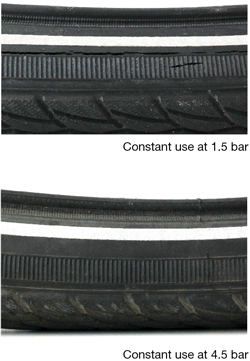
On the other hand, an under-inflated tire absorbs road shocks better. Wide tires are generally used at low pressure. The larger air volume is advantageous in that it absorbs road bumps and holes, but does not suffer from higher rolling resistance, less puncture protection or low tire wear.
How often should tire pressures be checked?
The inflation pressure should be checked and adjusted at least once a month. Even the best tubes constantly lose pressure as, contrary to car tires, the pressure required in bicycle tires is much higher and wall thickness much thinner. A pressure loss of 1 bar per month can be viewed as normal, but pressure loss will be much faster with high inflation pressures and much slower with low inflation pressures.
When using latex tubes, it is best to check and adjust the inflation
pressure before every ride.
Use a pressure gauge to monitor the inflation pressure. The widespread thumb-test method is very inaccurate, as all tires will feel identically hard from a pressure of 2 bar up. The thumb test is
completely insufficient for Marathon Plus tires due to the special
puncture belt.
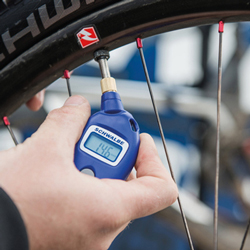
Our air gauge Airmax is suitable as a testing instrument. With the correct valve or a small adapter, inflation pressures can be tested and adjusted at a gas station. The purchase of a track pump with an air gauge is recommended for all active cyclists.
What is the correct inflation pressure for my tire?
It is impossible to make a general recommendation on inflation pressure for a specific bicycle or a particular tire. The “right” inflation pressure depends mainly on the load exerted on the tire. This weight is mainly influenced by the weight of the rider and any luggage. Contrary to a car, the vehicle weight is only a minor part of the total weight. In addition there is a great diversity of individual preferences with regards to low rolling resistance or suspension comfort.
The permitted inflation pressure range is marked on the tire sidewall. The higher the inflation pressure, the lower the rolling resistance, the tire wear and the less likelihood of a puncture. The lower the inflation pressure, the higher are the comfort and grip that the tires provide.
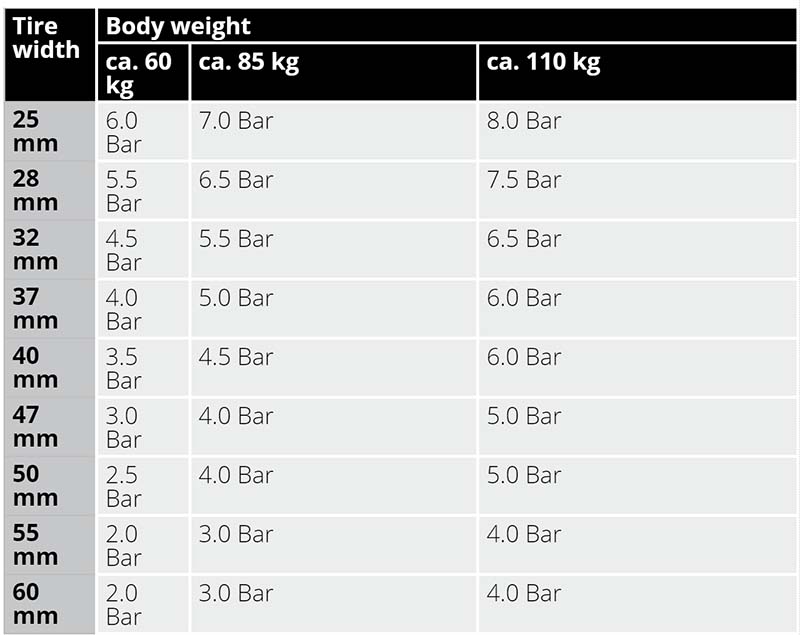
The list of inflation pressure recommendations on the right can only provide a very general guide. The recommendations are for an “average rider” weighing about 165 lb (75 kg).
If the rider is heavier or carries luggage, a higher inflation pressure should be used. For each additional kilogram that the tire must carry (bike, rider, luggage), the inflation pressure should be increased by approx. 1%. It is recommended that higher inflation pressures are used on very small diameter tires such as recumbants and folding bikes.
Lighter weight riders or riders who prefer a smooth or more comfortable ride can accordingly choose a lower inflation pressure, but the actual tire pressures should never be higher or lower than the maximum and minimum inflation pressures marked on the tire sidewall.
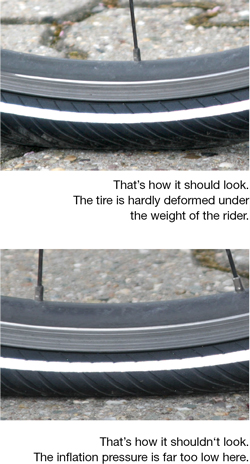
Fig.1:That’s how it should look.
The tire is hardly deformed under the weight of the rider.
Fig.2: That’s how it shouldnt look.
The inflation pressure is far too low here.
| Tire section width | Recommended inflation pressure | |
| 20 mm |
9,0 bar
|
130 psi |
| 23 mm |
8,0 bar
|
115 psi |
| 25 mm |
7,0 bar
|
100 psi |
| 28 mm |
6,0 bar
|
85 psi |
| 30 mm |
5,5 bar
|
80 psi |
| 32 mm |
5,0 bar
|
70 psi |
| 35 mm |
4,5 bar
|
65 psi |
| 37 mm |
4,5 bar
|
65 psi |
| 40 mm |
4,0 bar
|
55 psi |
| 42 mm |
4,0 bar
|
55 psi |
| 44 mm |
3,5 bar
|
50 psi |
| 47 mm |
3,5 bar
|
50 psi |
| 50 mm |
3,0 bar
|
45 psi |
| 54 mm |
2,5 bar
|
35 psi |
| 57 mm |
2,2 bar
|
32 psi |
| 60 mm |
2,0 bar
|
30 psi |